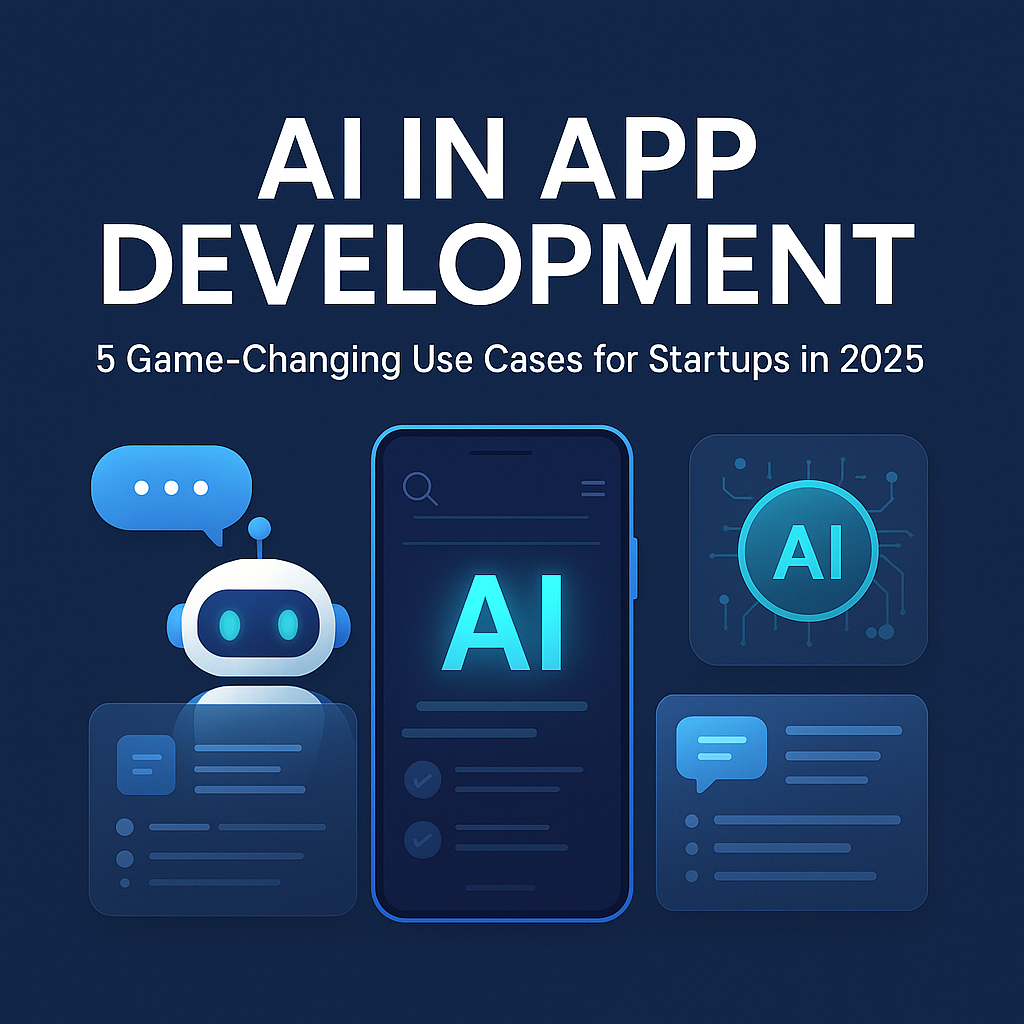
In 2025, artificial intelligence (AI) is no longer just a buzzword—it’s a foundational tool for startups aiming to innovate faster, reduce costs, and create smarter digital products. As consumer expectations rise and competition intensifies, AI in app development offers startups powerful ways to enhance features, personalize user experience, and automate processes.
In this article, we explore 5 practical AI use cases that 2025 startups can leverage to stay ahead of the curve.
🤖 Intelligent Chatbots & Virtual Assistants
AI-powered chatbots are now far more advanced than their rule-based predecessors. With the help of natural language processing (NLP) and large language models (LLMs), startups can build bots that:
- Provide 24/7 customer support
- Handle complex queries across multiple languages
- Qualify leads and onboard new users
- Act as in-app personal assistants or guides
Tools to explore: ChatGPT API, Dialogflow CX, Rasa, Microsoft Bot Framework
Example: A fintech app uses a bot to help users understand loan terms, check eligibility, and receive real-time transaction insights.
🎯 Hyper-Personalized User Experiences
AI enables apps to analyze user behavior and deliver tailored content, product suggestions, or UI adjustments in real time.
Examples include:
- Personalized news feeds or playlists
- Dynamic UI layouts based on user habits
- Adaptive learning modules in edtech apps
- Context-aware push notifications
Why it matters: Personalization increases retention and boosts user engagement—key metrics for early-stage startups.
🎯 Hyper-Personalized User Experiences
AI enables apps to analyze user behavior and deliver tailored content, product suggestions, or UI adjustments in real time.
Examples include:
- Personalized news feeds or playlists
- Dynamic UI layouts based on user habits
- Adaptive learning modules in edtech apps
- Context-aware push notifications
Why it matters: Personalization increases retention and boosts user engagement—key metrics for early-stage startups.
📸 AI-Powered Image and Voice Recognition
Startups in healthtech, retail, and accessibility are using AI for real-time media processing:
- Face recognition for secure login
- Voice commands for hands-free operation
- Object detection for AR shopping or inventory scanning
- Text-to-speech and speech-to-text for accessibility
Example: A medical app uses AI to scan and interpret X-ray images, helping doctors make faster diagnoses.
Tools: Google ML Kit, Amazon Rekognition, Apple Vision, OpenAI Whisper
🧠 Predictive Analytics for Smarter Decisions
AI models can analyze historical data to predict:
- User churn
- Purchase behavior
- Session drop-off points
- Future demand or stock levels
Startups can use these insights to:
- Improve app features
- Refine marketing campaigns
- Reduce costs
- Increase user lifetime value (LTV)
Example: An e-commerce startup predicts when users are likely to abandon carts and automatically triggers tailored discounts.
🔧 Automated Testing & Code Generation
AI is transforming the way developers build apps. Tools powered by machine learning can now:
- Generate UI components from sketches
- Recommend code snippets based on intent
- Write unit tests and detect bugs
- Auto-document APIs
This boosts productivity, reduces time-to-market, and minimizes human error—critical for lean startup teams.
Tools to explore: GitHub Copilot, Replit AI, Testim, Codeium, CodiumAI