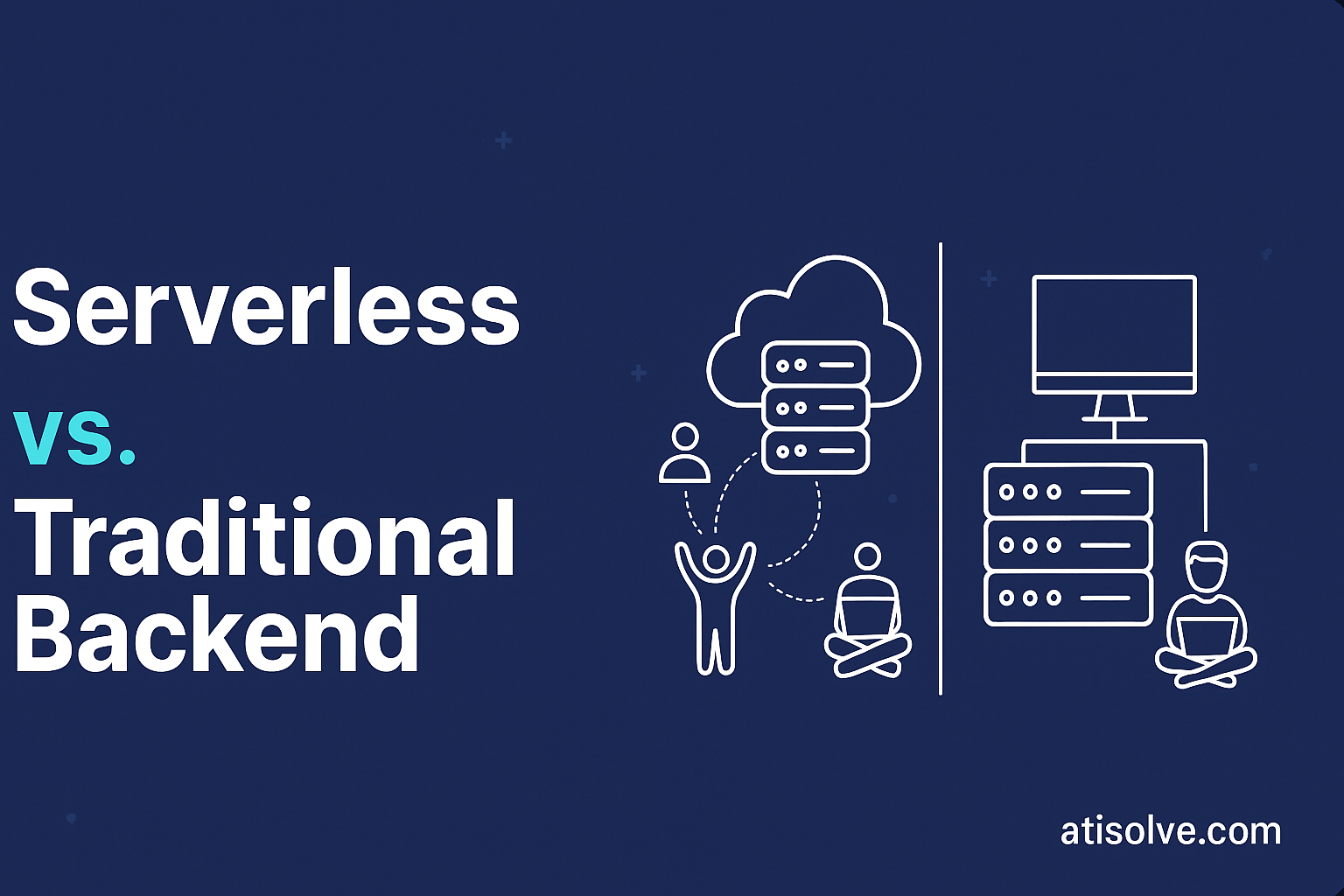
In today’s fast-paced digital world, choosing the right backend architecture can make or break your app’s scalability and performance. Two leading approaches dominate backend development: Serverless and Traditional (Server-based) architecture. But which one is best suited for your project, especially when rapid scaling is a priority?
Let’s explore both approaches, compare their strengths, and conclude with our expert recommendation.
🔧 What is a Traditional Backend?
A traditional backend involves managing your own server infrastructure. You typically provision a fixed number of servers (physical or virtual), configure web servers (like Nginx or Apache), and deploy your backend code manually or using CI/CD pipelines.
✅ Pros:
- Full control over server environment and configurations
- Easier to integrate with legacy systems
- Better for long-running background tasks or persistent connections (e.g., WebSockets)
❌ Cons:
- Requires ongoing server maintenance and patching
- You pay for server uptime, even when idle
- Difficult to scale automatically under heavy load
☁️ What is Serverless Architecture?
Serverless doesn’t mean “no servers.” It means developers don’t manage infrastructure. Cloud providers like AWS (Lambda), Google Cloud (Cloud Functions), or Azure (Functions) run your backend code on demand. You’re only billed for the compute time used.
✅ Pros:
- Auto-scaling: Instantly handles thousands of concurrent requests
- Cost-effective: Pay only for actual usage (no idle server costs)
- Faster deployments: Focus only on writing business logic
- High availability: Built-in fault tolerance and regional redundancy
❌ Cons:
- Cold starts may add latency
- Limited execution time (e.g., AWS Lambda’s 15-minute max)
- Harder to debug in some cases
- Vendor lock-in risks
🧠 So, Which One is Best for Fast Scaling?
Our recommendation: Go Serverless if scaling fast is your priority.
For startups, SaaS platforms, mobile backends, or real-time APIs — serverless is unbeatable in terms of agility, cost, and performance. It allows you to launch quickly and scale seamlessly without worrying about DevOps overhead.
However, for enterprise systems with legacy dependencies or applications requiring persistent connections (like chat apps or game servers), a traditional backend might still be appropriate.
Choosing the right backend architecture is all about aligning with your product goals. If you prioritize rapid development, scalability, and cost-efficiency — serverless is the future.
Need help building a robust backend with the right stack?
👉 Contact our expert team at atisolve.com – your trusted tech partner for scalable backend solutions.